The short answer
Reliable memory needs a source, a scope and a way to handle change.
Define a memory record and test whether a fresh session can retrieve it.Start with a question you will ask again
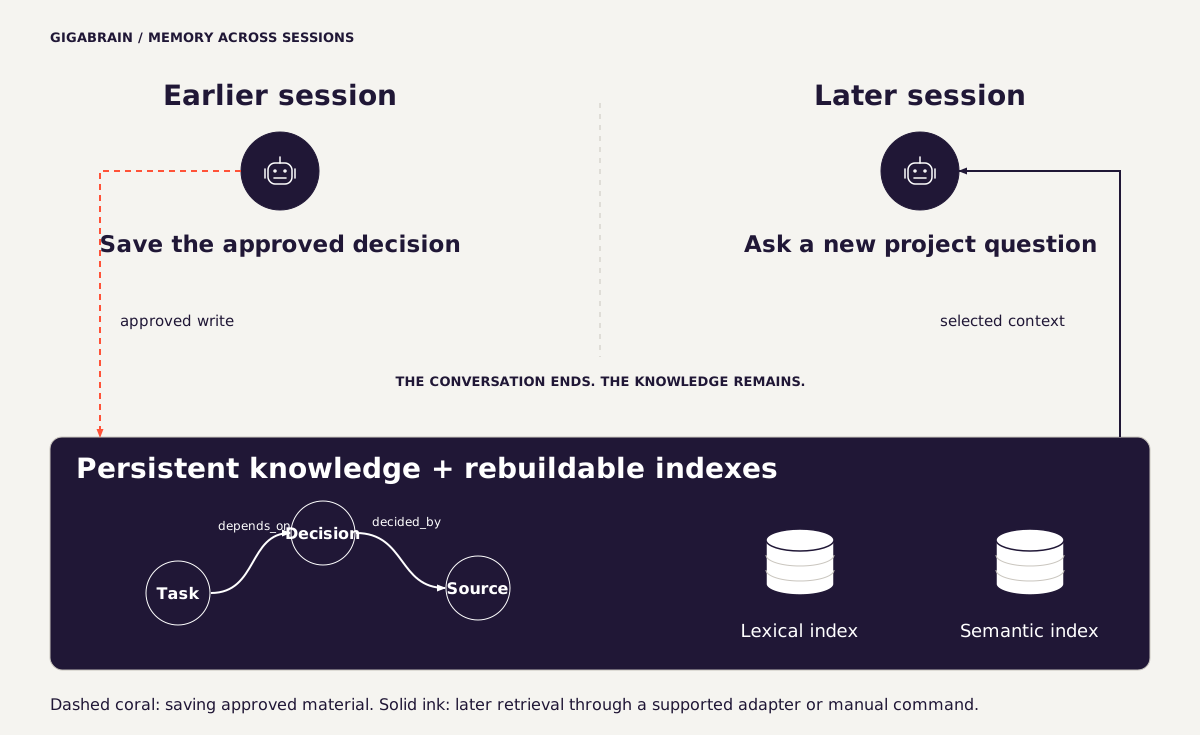
Persistent memory keeps information outside the current conversation so an AI agent can use it later. Test it in a fresh session: can the agent recover the right fact, show its source and handle a correction? A saved transcript alone does not establish that behavior.
Choose one recurring task before importing a whole archive. A weekly project review is a good starting point: the same project names, commitments and deadlines return, but some facts change. Write down five questions you expect the system to answer. Include one question whose answer is absent.
"What is Project North's current delivery date, which source establishes it, and did it replace an earlier commitment?" A useful answer needs the current date and its history.
Separate the four jobs of memory
| Job | What to keep | How to check it |
|---|---|---|
| Capture | The original source, its date and origin | Can you open the original? |
| Organize | Project, people, decisions and meaningful relationships | Can you distinguish two similarly named projects? |
| Retrieve | An index and a way to select relevant passages | Does the result include the needed passage? |
| Maintain | Corrections, deletions and review decisions | Does an old fact stop being presented as current? |
A failure can happen at any step. The note may be wrong. Retrieval may miss an accurate note, or the agent may misread the right passage. Keep the source beside the answer so you can see which step needs attention.
Run a small, repeatable memory exercise
This is an illustrative exercise, not a reported Gigabrain benchmark. Use fictional material in a separate test project.
- Save a note saying that Aster supplies Project North and delivery is 12 October.
- Import the note and update the retrieval index using your system's supported process.
- Close the conversation. In a fresh session, ask for Project North's delivery date and supporting source.
- Add a dated amendment: delivery is now 18 October, replacing the earlier commitment. Update the index and repeat the question.
- Ask for the warranty duration, which neither note states. Expect an explicit missing-evidence answer.
- Repeat the question in a separate project without those sources. Check that the first project's facts do not appear as its evidence.
Save the exact query, retrieved passages, answer and source path for every run. Repeating a question in the same conversation can test conversational context rather than durable retrieval.
Set rules for corrections and forgetting
Keep history without confusing it with current truth. An amendment should identify what it changes, when the change applies and which source supports it. Rebuild or update the retrieval index when source material changes. Otherwise, the agent may continue to see a removed passage.
Decide what deletion means across source files, derived notes, indexes, backups and any connected provider. Removing one note does not prove that every copy has disappeared. Give one person responsibility for resolving contradictory commitments instead of asking the agent to silently choose a winner.
Decide what deserves to become memory
Not every sentence in a conversation deserves a permanent record. Separate a stable preference, a project fact and a proposed action. "Use US English for this client" might be a scoped instruction. "The client approved the proposal" is a factual claim that needs a source. "We should send the proposal tomorrow" is a suggestion until somebody approves it.
A useful memory record can be understood without replaying the conversation that created it. Write who or what it concerns, the claim, the supporting source, its effective date and its scope. Keep an unresolved proposal out of the collection of approved decisions.
Project: North
Claim: Delivery is now 18 October.
Evidence: Dated amendment, paragraph 2
Effective from: Date specified by the amendment
Replaces: Original 12 October commitment
Scope: Project North only
Review owner: Person responsible for delivery
This is a planning template, not Gigabrain import syntax. Dates and ownership must come from your actual sources. If a note supplies no effective date, record that gap instead of silently using the import time.
LangChain's memory overview separates stored facts, experiences and instructions. That is a useful design distinction even outside its framework: a recalled experience can inform a suggestion without becoming a standing instruction.
Use the memory-record template to decide what you will capture and who can approve a change.
Choose the smallest system that passes
A handful of stable reference notes may need only careful files and a repeatable prompt. A growing body of changing project knowledge benefits from ingestion, retrieval and explicit relationships. A multi-tenant service needs operational controls beyond a personal knowledge kit.
Gigabrain combines source ingestion, semantic and lexical retrieval, and a source-linked knowledge graph to keep project knowledge available across sessions. Its public evidence describes the current connected-source demonstration and its limits. The compatibility page shows which agents can call the tools automatically and which need manual commands.
Start with Gigabrain System. Add the Loop Pack if you want the 24 prepared automations and its update benefits. First use the memory workbook to define what success means for your work.
Reference and scope
LangGraph's memory documentation distinguishes thread-level state from memory across conversations. That distinction helps frame the test. Gigabrain is a separate product, and this guide does not claim a LangGraph integration.
Follow a connected source through a correction
Our fictional Project Alder depends on the Kestrel access review. That review follows the Monday schedule. The schedule initially sets the inspection for 18 October.
| Source | What it establishes | What remains unknown |
|---|---|---|
| project.md | Alder depends on the review. | The inspection date. |
| review.md | The review follows the schedule. | The date in that schedule. |
| schedule.md | The inspection is scheduled for 18 October. | Whether the inspection will pass. |
We reproduced the connected-source demonstration against the System and Full 1.1.0 archives. It used the local memory service, hybrid retrieval and graph expansion.
The service reached the schedule through the connected records. After the fixture changed the date to 25 October, the old citation failed verification. Refreshed retrieval quoted the new date.
Inspect the recorded passages, relationship paths and archive hashes. The output contains source quotations. It does not measure generated-answer quality or demonstrate a fresh agent conversation.
The fixture changes a disposable source file to test invalidation. In normal work, preserve the original document and add a dated amendment.
Check whether your agent actually uses the memory
- Create a separate test vault.
- Add the fictional records.
- Complete the supported setup for your agent.
- Start a new conversation without pasting the project facts.
- Ask for Alder's inspection date and its supporting source.
- Inspect the tool invocation and returned passage.
- Record facts the agent adds beyond that passage.
This acceptance procedure is separate from our local service demonstration. A correct answer without a recorded retrieval step does not establish that persistent memory supplied it.
Then ask about the supplier's warranty duration. These records cannot answer that question. Inspect whether the response acknowledges the gap, even if retrieval returns related passages.
Carry a recurring task into the next session
Save an approved project decision with its source and date. In a new session, ask for that decision before drafting a follow-up. Add a correction, refresh the sources and repeat. Check that the next draft uses the new decision.
Decision: ____
Source and date: ____
Correction: ____
Next-session result: ____
The Loop Pack includes the prepared automations. Choose their tools, permissions and schedule during setup. Explore the Loop Pack.
Method note: Gigabrain Labs prepared this article with AI assistance. Linked records define the measured scope. Fictional exercises remain separate from executed results.