The short answer
Check where your data goes and which parts you will need to maintain.
Compare operation, recovery and cost using one representative task.Decide who will run and maintain the system
Local AI memory runs on a device you control. Hosted infrastructure puts some of the storage and operation with a provider. Many workflows combine the two: the files stay local, while a hosted agent receives selected material to reason over.
Draw the path of one source from import to final answer. Mark every device, provider and backup destination it touches. That drawing is more useful than a broad "private" or "cloud" label.
Compare who does the work
| Decision | Local system | Hosted infrastructure |
|---|---|---|
| Availability | Your device and scheduling need to be available | Provider availability and service terms matter |
| Access | You manage files, device access and sharing | Check account roles, tenant boundaries and access logs |
| Recovery | You own backup and restoration checks | Verify exports, retention and recovery options |
| Change | You apply and verify software updates | Provider changes may affect behavior or APIs |
| Scale | Device capacity and coordination become constraints | Quotas, usage costs and isolation need evaluation |
| Exit | Inspect your files and dependencies | Test a complete export before you rely on it |
Compare these features in the products you are considering. With local storage, you still need to check encryption, access controls and backups.
Walk through three common situations
An individual with one working computer: a local system may suit your project files and a file-capable agent. The person needs to manage setup, updates and backups. They should check which operations require network access.
A small team sharing project knowledge: ownership, concurrent edits and source permissions become central. A shared folder is not a complete access-control design. Test how two agents work on the same project and how confidential sources stay separate.
A product serving many customers: evaluate tenant isolation, service availability, deletion, observability, authorization and operating cost. A local knowledge system and a managed service for multiple customers have different operating requirements.
Calculate the cost of the workflow
List the licence, agent subscription, optional provider usage, hosting or device costs, setup time and ongoing maintenance. Count the same period for each option. Separate one-time costs from recurring commitments and avoid comparing a purchase price with a monthly fee without a time horizon.
Also list who fixes a failed import, restores a damaged index and handles an integration update. Include the time someone will spend on those repairs. Otherwise, the option with the lowest price can turn out to cost more to run.
Test an exit before committing
- Export a representative project with its source references.
- Open it without the original product where the format permits.
- Check whether relationships, dates and attachments survived.
- Restore from your backup or export into an isolated environment.
- Document what deletion removes and what remains in other copies.
Check which export and restore steps your chosen product supports. Ask the supplier about any step that fails.
Draw the boundary around one real task
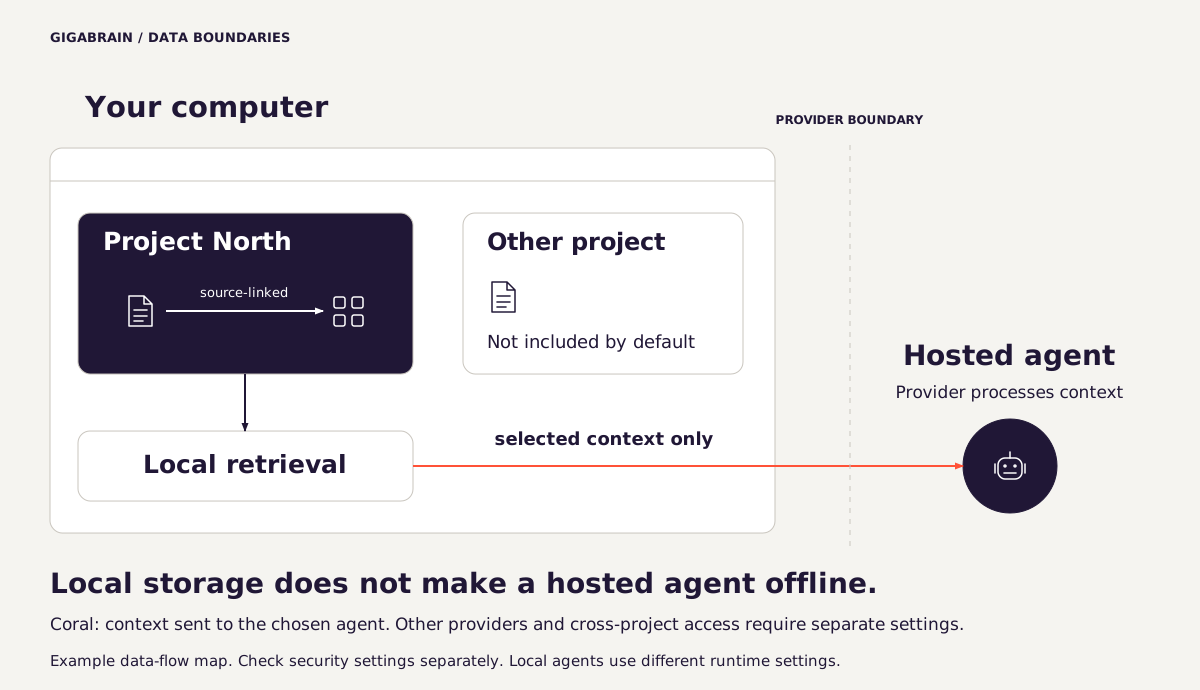
Consider a person preparing a client meeting brief. Their notes sit on a laptop, retrieval runs locally, and a hosted agent receives selected passages to draft the brief. Calling the entire workflow "offline" would hide the part that leaves the device.
List the material at each step. The original folder may remain local while a passage, prompt and generated answer travel to the agent provider. A remote Git backup can contain a different set of files again. Each destination needs its own permission and retention decision.
Task: Prepare a client meeting brief
Originals: Local project folder
Retrieved context: Selected passages and source references
Reasoning destination: The configured agent provider
Output: Draft brief saved to the approved workspace
Other copies: List enabled sync and backup destinations
Open question: Which histories and logs does each provider keep?
This example shows how data might move through a task. Map your own setup using its settings and available operation logs. A setting that disables one optional authoring provider does not determine how a separate hosted agent processes its context.
Download the data-flow worksheet and complete it before the pricing comparison. If your chosen agent cannot receive a required source, resolve that restriction first. A cheaper licence or a larger context window will not resolve the permission boundary.
Who Gigabrain is for
Gigabrain combines semantic and lexical retrieval with source ingestion and a persistent knowledge graph, for people who want to run their agent’s knowledge infrastructure locally. Its ordinary ingestion, indexing and retrieval run locally. Hosted agents, optional cloud graph authoring, updates, sync and remote Git can each use the network.
If you need a managed service for many customers or centralized enterprise administration, evaluate infrastructure designed for those requirements. If local control fits your work, inspect how Gigabrain works, check compatibility and compare packages. Choose an operating model you can maintain.
Compare responsibility for one inspection brief
Suppose Project Alder's schedule changes while a laptop is asleep. A local retrieval service cannot refresh files on that sleeping device. A hosted deployment also needs a working source connector and update process.
| Task | Locally operated workflow | Hosted workflow |
|---|---|---|
| Approve the schedule source | The owner selects files and permissions. | The customer configures authorized access. |
| Keep retrieval available | The operator maintains the device and runtime. | The provider's service terms define its responsibility. |
| Interpret a changed commitment | A reviewer checks the amendment. | A reviewer still checks the amendment. |
| Recover an earlier version | The operator tests local backups. | The customer checks available exports and recovery terms. |
A graph database can run locally or on hosted infrastructure. Compare the actual deployment and maintenance responsibilities of the system you choose.
Complete the data-flow worksheet for the exact configuration. Record where the agent sends context as a separate decision from where the index lives.
Method note: Gigabrain Labs prepared this material with AI assistance. Fictional exercises and executed component checks have separate labels.